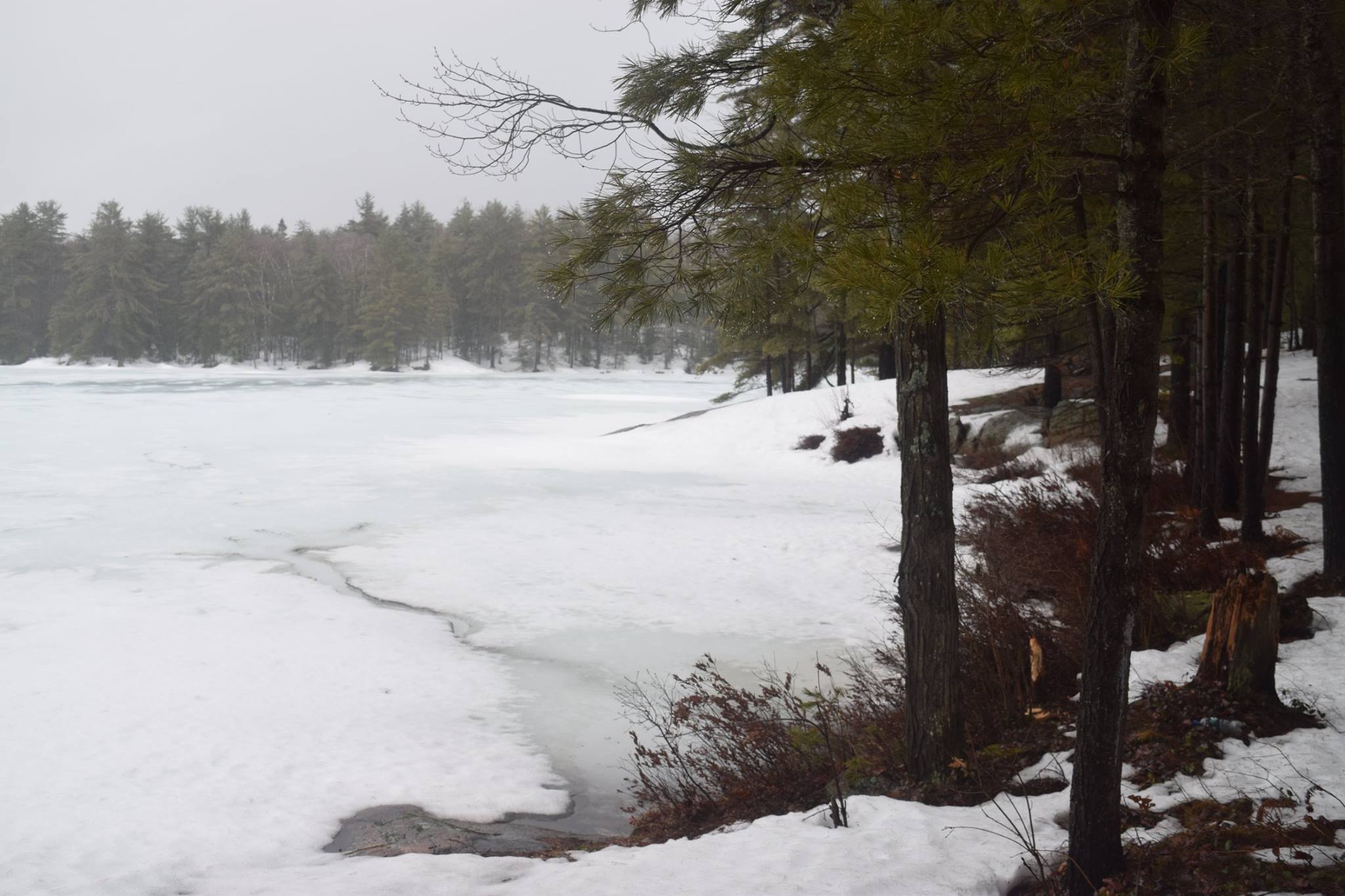
 As I walked down the narrow path towards the lake that I knew so well, my surroundings became unfamiliar. A heavy fog surrounded the lake making it difficult to see the other side. Happy memories from spending my childhood seemed to fade away through the mist, leaving an empty feeling in the pit of my stomach. Across the lake, I saw figures and shapes that I did not remember seeing before. Was it my eyes just playing tricks? Or was there something there that isn’t usually. I took a deep breath and waited as the fog began to lift, leaving the lake I have always known. The figures disappearing with the fog itself. The sun began to shine as I walked back towards the trail to the main road. So many questions forming in my mind as I walk through the deep snow.
I recently went to visit my personal watermark in my hometown, Haliburton, Ontario. In the photo above, it is seen that a heavy fog appears over the lake. This made me feel as though I was in a frightening environment because the fog gave off an eerie vibe. I began to think about how the fog had formed and why I began to feel as though I was in a frightening environment. I wondered why such a natural occurrence could lead to such an uneasy feeling. Even though I had been to this lake countless amounts of times, the fog that I saw made me feel unfamiliar with this lake. At that moment, a lake that I originally associated with happiness was turned into a place of uncertainty. I knew that the same lake that I have visited many times was still there, however, the fog that formed above and around it made it seem like I was in a completely different place. One that I was not familiar with in the slightest.
After I went back home, I did some research to see if others experienced what I had just experienced myself. I came across a scholarly source by Canada NewsWire which perfectly answered my questions. The text reads, “Mark Newman’s photograph of a thick layer of steam fog over an unidentified British Columbia lake was taken just as an icy wind caused humid air to condense over the warmer surface. The image beautifully captures a moody, almost ghostly, scene” (Canada NewsWire). This gave me a brief explanation of my previous questions. I also did further research about how fog forms.
I came across a fascinating article by Tega Jessa which explains this phenomenon. The article reads, “In general we see that fog is formed whenever there is a temperature difference between the ground and the air. When the humidity is high enough and there is enough water vapor or moisture fog is sure to form. However the kind of fog and how long is last and its effects will depends on the different conditions mentioned. One interesting kind of fog actually helps to make snow melt faster” (Jessa, 2011). Reading this helped me to understand what I was seeing that day on the lake. This brought the scientific explanation to this beautiful, artistic scene.
After answering the questions about why fog forms, I wanted to know why fog makes people feel frightened or uneasy. After some research, I came across an article by Edward Bozman that explains this aspect. The article talks about Homichlophobia, which is the fear of fog and humidity. The article says, “It is generally accepted that phobias arise from a combination of external events (i.e. traumatic events) and internal predispositions (i.e. heredity or genetics). Many specific phobias can be traced back to a specific triggering event, usually a traumatic experience at an early age” (Bozman, 2007). It was really interesting to read about this because I would not even think about phobias when I look at some fog on a lake.
It is also common to feel uneasy when looking at fog because it is seen in many horror movies, and it tends to block out the sunshine making one’s surroundings dark and gloomy. Another article that I found explains this occurrence in detail. The article reads, “Maybe it’s the way you feel alone in the fog, even with your companion next to you. Maybe it’s how the fog seems to swallow everything and makes noise and sight unfamiliar. Maybe it’s the way it curls and sways around you, as if it knows you are there. Maybe it’s the fact that a monster could lurk a few meters from you and you wouldn’t know it” (TVTropes). This gives many possible explanations for why people may feel anxious around fog. It definitely seems like a combination of things rather than just one particular detail. That in itself is interesting because every single person will have a different reaction to fog and have a different reason why they are scared of it.
By observing the fog in detail, I came to appreciate the world around me and how amazing it really is. Instead of just looking at it briefly without much thought, I realized that there is always a deeper meaning to everything around me. Instead of just commenting that the fog looks frightening, I asked myself why does the fog look frightening. This is an example of critical thinking. Critical thinking, in general, means asking questions about things to get a more in-depth understanding of it.

 Lochlin Lake in the Winter